Friday, July 12, 2013

Timeshare Scams Target the Elderly

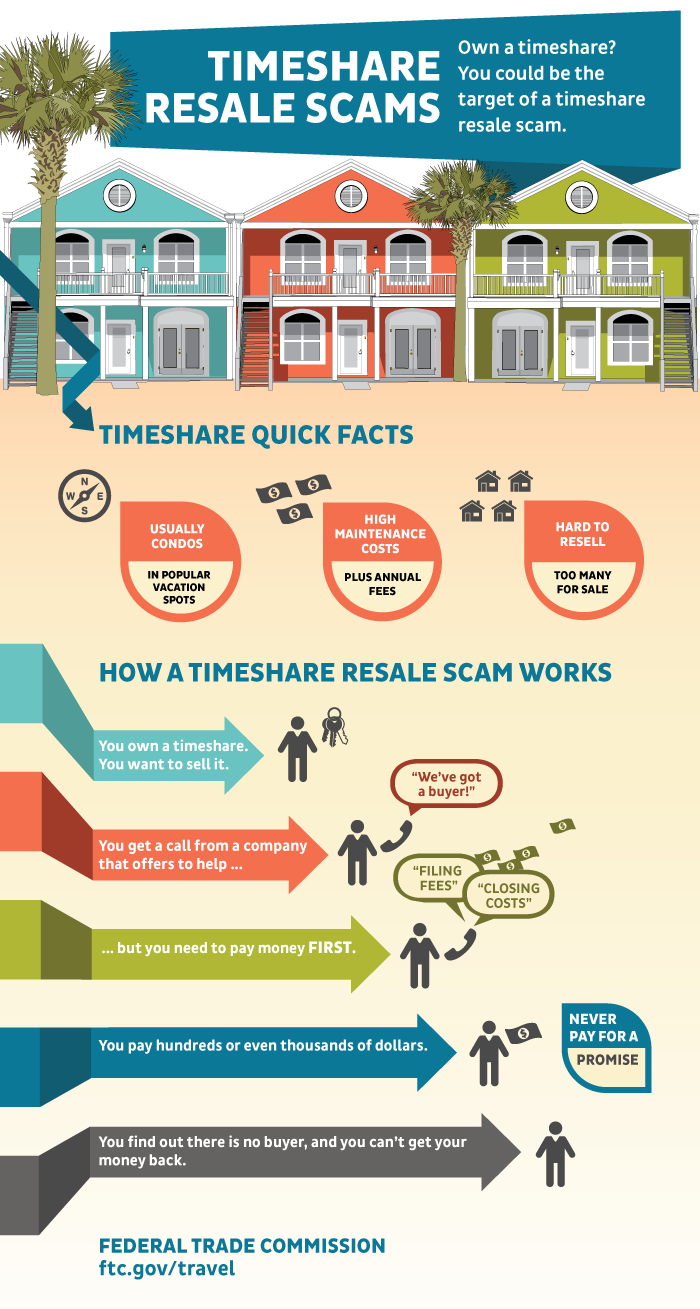
For too many elderly timeshare owners, their dream vacation getaways have turned into nightmares. As bad economic times force them to sell their timeshares, con-artists hawk promises to line up buyers when all they intend to do is take the owner's money – lots of it. Timeshare scammers also connive to trap the elderly in travel-prize schemes that turn into money holes.

Fortunately, the authorities are onto them. The Federal Trade Commission (FTC) announced 191 law enforcement actions to crack down on timeshare-resale and travel-prize scams, including three FTC cases, 83 civil actions in 28 states, and 25 law enforcement actions in ten other countries. 
 
All told, these swindlers bilked their victims out of tens of millions of dollars and 184 people face criminal charges so far. The FTC's announcement comes less than a year after timeshare-resale and travel-prize scams made the Consumer Federation of America's top-ten list of consumer complaints.

"Con artists take advantage of timeshare owners who have been in tough financial straits and are desperate to sell their timeshares," according to the agency. "They persuade owners to pay fat up-front fees by saying they have someone ready to buy the property, but that’s a lie."

Even worse, after a resale scammer has disappeared with thousands of dollars with no buyer in sight, a second con artist calls claiming to represent a "resale recovery services" firm, according to Forbes. This individual makes a false promise to recover the funds lost from the first fraudulent transaction for another hefty fee. After paying the fee, the victim never hears from them again.

The pressure may be intense for a timeshare holder, who can be on the hook for on-going maintenance fees (sometimes thousands of dollars per year) when the management companies fail to honor their contracts.

Typical travel-prize scams lure victims to high-pressure sales presentations with promises of free or discounted travel. For example, Forbes reports that Festiva promised large-screen TVs or cruises to seniors who attended Festiva sales presentations.  The office of the Louisiana Attorney General, which handled scores of complaints against the company, reported that "Once there, [victims] were forced to listen to a six-hour sales pitch. Some never received their ‘prizes,’ others complained that the free cruises ended up costing hundreds of dollars in fees."

To avoid getting scammed:

  • never pay for a promise and be suspicious of up-front fees (don't pay until your unit is sold, advises the FTC)
  • always get everything in writing first
  • have any documentation reviewed by a trusted financial advisor, realtor, or attorney before signing – if a sales rep pressures you to sign or pay something immediately, don't
  • pay close attention to maintenance responsibility and rules for selling a unit
  • before agreeing to anything, check for complaints against timeshare resellers by going online, or contacting the state Attorney General and local consumer protection agency

Wednesday, June 26, 2013

Google Invests $7 Mill to Stop Child Porn Access

Jacquelline Fuller, the director of Google Giving, recently announced that the company's investing $5 million to support efforts by the National Center for Missing & Exploited Children (NCMEC) and international organizations to rid the web of child exploitation. Google's also ponying up $2 million to encourage more effective tool development to combat Internet child sexual abuse.

To underscore the urgency of its effort, Google reports that the NCMEC’s CyberTipline reviewed 17.3 million suspected child sexual abuse images in 2011 – quadruple the amount seen in 2007 by its Exploited Children's Division.

Fuller says the search engine has used hashing technology to tag offending child sexual images with unique computer-recognized ID's since 2008.  What's new, the announcement declared, is that Google's beginning to "incorporate encrypted 'fingerprints' of child sexual abuse images into a cross-industry database [that other tech] companies, law enforcement and charities [will share] to better collaborate on detecting and removing these images, and to take action against the criminals."
 
However, some critics say these measures do not go far enough, since they narrowly focus on the searchable web. It's said that this web-based focus may neglect the shadow Internet and peer-to-peer (P2P) networks, which allow child predators to directly share pornographic images with one another without going through a central server or search engine. As an alternative, NetClean CEO Christian Berg claims to provide technology that can scan servers, laptops and desktops for known child abuse images, rather than URL-based tools that Google is using: "We’re not talking about URLs, but actual files, which means we can find things on USB sticks too," says Berg. He adds that the next step is "to do an investigation and notify the police."

Google's multi-million dollar cooperative investment, when added to existing and emerging technology, appears to be a strong step in the right direction to put criminal child sexual abuse images in the hands of law enforcement and out of the public domain. Philly.com says "Law enforcement agencies are already using PhotoDNA to track and identify offending images. ... It’s possible law enforcement agencies could now use both the 'fingerprints' and 'DNA' of images and videos as a means of tackling tens of millions of images."

What can you do? Start a conversation with your children (or keep one going) so they feel comfortable discussing online problems they encounter, and cyber risks, including:
  • consequences of revealing personal information (name, age, address, telephone, pictures)
  • "private chats" with a stranger
  • meeting alone with anyone they met online 
  • predators seeking child victims and lying about their age, sex, and identity
  • responding to suggestive, obscene, belligerent, or harassing messages – instead, report these messages to CyberTipline or the police
Tweens and teens also need to know that sexting (sending a nude or semi-nude image in a text to someone) is a form of child pornography, even if the minor created the image. Besides ruining a child's reputation among their peers when these images are shared, they can end up in the hands of child predators or sextortionists.

If your teenager needs to talk to someone but may feel more comfortable talking to another teen, they can call Teen Line for confidential help and support at 800-852-8336 every evening 6 to 10 p.m. Or they can text "TEEN" to 839863.

Monday, June 17, 2013

Enslaved in the USA: Testimony of a Child's Survival

At a recent U.S. Senate Finance Committee hearing, Chairman Senator Baucus declared child trafficking a form of slavery that "exists right here in America" and is "quickly becoming one of the fastest growing criminal industries in the world."

"At least 100,000 children are exploited every year in the United States ... and most victims are between just 12 and 14 years old," said the senator. The senator also stated that because many Child Protective Service (CPS) workers are unfamiliar with human trafficking laws and "don't know how to handle cases involving trafficked children ... sex trafficking victims are often arrested and placed in juvenile detention facilities," and treated like criminals.

The senator's words echoed the experience of sex trafficking survivor and FAIR Girls Maryland Program Coordinator Asia Graves. Her story is a tragically common illustration of how the cycle of abuse continues until someone recognizes the warning signs and takes steps to stop it.

Asia's mother was a crack-cocaine addict and abuse victim herself, and her father was an alcoholic. Asia testified before the Senate committee that:

80 to 90% of victims of trafficking [victims] have been sexually abused. That is my story, too. I was raped [by] my mother’s drug dealers from the ages of 6 to 10 years old, which made me vulnerable to trafficking. I went to school and told my teachers as well as a school social worker who just believed that I was making it up. I stopped asking for help. My life as an American victim of modern day slavery could have been prevented. [T]he teachers and social workers who met me did not see the warning signs. By the time my pimp sold me, I was isolated and scared, which is exactly what most girls feel as they fall victim.

Enslaved at 16, a series of pimps sold her for sex all over America. She finally escaped three years later, and subsequently rebuilt her life with the help of a strong team of women leaders. "I hope someday to be a lawyer," she testified, "and take my past and use my work at FAIR Girls to truly ensure fewer girls fall victim to sex trafficking."

Asia recommends funding to open specialized homes for human trafficking victims, education for social workers and teachers to recognize and report trafficking red flags, and education for high risk youth inside the child welfare system to learn how to stay safe.

Congress has introduced legislation (SB 1118) to address child trafficking by, among other things, requiring state child welfare agencies to immediately report missing or abducted children to law enforcement.

Tuesday, June 4, 2013

Robot & Grandma

A couple of years ago, a "Skype-on-wheels" robot named Celia allowed adult children to remotely check on their aging parents. Now there are robots that could do the dishes, give them a bath, and hold a conversation.

Recently, a New York Times article gazed into the future of robotic caregiving to pose a "fundamental" question: "Should we entrust the care of people in their 70s and older to artificial assistants rather than doing it ourselves?"

The answer, of course, depends on who you ask. The makers of Paro (a furry baby-harp-seal-shaped therapy robot made to respond to its name, coo when petted, or cry when squeezed), would point to the technology's successes in treating Alzheimer's patients.

Similarly, Carnegie Mellon University (CMU) has designed a robot that can blink, giggle, and develop a personality when people interact with it, to assist in the therapy of people with autism. CMU roboticist Jim Osborn claims that "Those we tested it with love it and hugged it [and began] to think of it as something that is more than a machine with a computer."

But author and MIT professor Sherry Turkle is less sanguine. On seeing a 76-year-old patient share stories with the cuddly Paro, Turkle said, "I felt like this isn’t amazing; this is sad. We have been reduced to spectators of a conversation that has no meaning.... Giving old people robots to talk to is a dystopian view that is being classified as utopian."

Still others would say that personal assistant robots fill an important need at a time when the aging population is exponentially outpacing the caregiver pool.

But even robots that perform simple tasks (and don't do therapy) may come with psychological costs.

David E. Williams, in the Healthcare Collective blog calls it "spooky" that robots can give baths and do other personal tasks. Even if all the robot does is pick up, wash, and put away the dishes, Williams says, "you encounter issues of learned helplessness. If the robot can do it, why make the effort, even if effort is what provides purpose in life and staves off physical and cognitive decline?"

Tuesday, May 28, 2013

Finding a Caring Caregiver

If an elderly loved one needs at-home care, how do you select a professional caregiver? With careful screening of the person or agency before making your choice.

Tragically, some caregivers physically or verbally abuse their patients — or simply neglect them. And financial exploitation, which leaves no visible marks, can be just as devastating.

Unfortunately, one does not need to look far for examples:
  • A Georgia homecare nurse caught on an ATM camera using her elderly patient's debit card, was indicted on charges of elder abuse and financial transaction card fraud for swiping more than $7,500 from the 86-year-old victim, $2 to $300 at a time.
  • In Illinois, a hospital nursing assistant befriended her 89-year-old dementia patient, and upon his discharge became his round-the-clock caregiver. Prosecutors say she obtained a power-of-attorney, allowing her to steal over $350,000 from his estate which she used to buy a new Mercedes, remodel her home, and enrich herself and her family. The caregiver was held on $350,000 bail and faces up to 15 years in prison on charges of felony financial exploitation of a senior.
Lack of caregiver screening, training, and experience accounts for many cases of elder abuse. As the Huffington Post reports, the Journal of American Geriatrics Society published a study finding that, nationwide, many caregivers are dangerously unqualified because agencies fail to conduct background checks, drug testing, or to require experience or training of new hires. Researchers conducting the study surveyed 180 agencies, but found that only 55 percent conducted federal background checks, and one-third administered drug tests.

The article includes these tips for choosing a caregiver:

Thursday, April 11, 2013

Babies Teach Empathy

In November 2011, a 15-year-old Nova Scotia girl was gang-raped. After someone used their cell phone to circulate a photo of the sexual assault, Rehtaeh Parsons endured more than a year of cyberbullying and harassment until she couldn't take it anymore. Rehtaeh was taken off life support on April 7, 2013 – three days after she tried to hang herself.
 
Rehtaeh's mother wrote on her Facebook tribute page, "Rehtaeh is gone today because of the four boys that thought that raping a 15-year-old girl was OK and to distribute a photo to ruin her spirit and reputation would be fun. All the bullying and messaging and harassment that never let up are also to blame. Lastly, the justice system failed her. Those are the people that took the life of my beautiful girl."

How can we prevent tragedies like these? An anti-bullying program that is gaining national attention centers on babies teaching empathy to young children. Roots of Empathy is a social and emotional learning program for K-8 students which started in Toronto. The mission of the program is to reduce aggressive behavior as a way of decreasing bullying. In 2007, the program was introduced to US schools, and has spread to California, New York, and parts of Washington.

Baby Claire visits a kindergarten class once a month, and a Roots of Empathy instructor also visits the classroom to help the students recognize Claire's development and label her feelings. The students then discuss why Claire is happy or sad, and how they have similar feelings.


A 2011 study of 270,000 students compared those students who participated in social and emotional learning programs like Roots of Empathy, with those who didn't. The study found that the students in these programs not only had increased social and emotional skills, but they also had an 11 percent increase in standardized achievement test scores.

Claire's mother says, "The tone of the room changes when Claire comes in, and I think kids start to think about how it feels to be treated a certain way, because they don't like it when she gets upset."

Monday, March 25, 2013

Educating Teachers on Mandated Reporting

We wrote an earlier post about an elementary school principal in San Jose, California, who was convicted of misdemeanor failing to report suspected child abuse after a mother and her daughter told the principal about a second-grade teacher who acted "strangely" while alone with the girl in a classroom.

In Brentwood, California, the school district paid $950,000 to settle a lawsuit against one of its special education teachers, Dina Holder, who pleaded no contest to misdemeanor child abuse after throwing a five-year-old special needs student onto the floor and kicking him. The teacher's aides reported the incident to the school principal who waited two days before calling Child Protective Services (CPS), and never submitted a follow-up written report as required by law.

As a result of reports like these, the Bay Area News Group conducted a survey of California school districts and found that less than half that responded had provided annual training on recognizing and reporting suspected child abuse.  And, some districts didn't understand what the law requires. For example, some districts require employees to first report suspected abuse to school administrators rather than calling the authorities. However, the law requires mandated reporters to report their suspicions directly to CPS or police – reporting to school administrators does not fulfill their legal duty.

This survey prompted California's State Superintendent of Public Instruction, Tom Torlakson, to send a letter to all school districts, requesting information about their child abuse training.  Torlakson also said he would support legislation to strengthen the state's mandated reporter law.

California Assemblywoman Joan Buchanan has introduced legislation that would require all school districts to adopt policies outlining child abuse reporting requirements and to review those policies annually with all employees.

However, William Grimm, senior attorney at Oakland's National Center for Youth Law, doesn't think the proposed legislation goes far enough. "A large part of the problem is the district's failure to provide training that helps school staff understand what should be reported. Until training is mandated for all school staff, there will continue to be victims whose suffering goes unreported."

Tuesday, January 22, 2013

Protect Our Kids Act of 2012

According to the polls, more Americans were outraged after the school shooting in Newtown, Connecticut (75%), than after the September 11th terrorist attacks (65%).   

The same week that he announced proposals to reduce gun violence in response to the Newtown tragedy, President Obama launched a less-publicized movement to protect children when he signed the Protect Our Kids Act of 2012 which authorizes a Commission to study deaths caused by child abuse and neglect.  "The key to child abuse prevention in general  ... is awareness and then it's education.  And, people need to be aware that this is a problem," says Christal Wilcox Frost of Traverse Bay Area Child Advocacy.  

Data from the US Centers for Disease Control and Prevention for 2008 and 2009 found that eight children and teens (ages 0-19) die every day from gun injuries. 

Available statistics tell us that five children die from abuse or neglect every day in the US, the worst record of any industrialized nation.   However, Teri Covington, director of the National Center for Child Death Review says, “It’s been well-documented that those numbers are underreported, perhaps as high as 50 percent. Child abuse cases often don’t show up on death certificates because a lot show up as injuries or accidents.” 

The goal of the Protect Our Kids Act is to make more people aware that child abuse and neglect is a preventable and under-reported epidemic. Let's hope that the Commission's findings inspire the same outrage and call to action as the Newtown tragedy.

Thursday, December 20, 2012

Making Sense of Statistics

The U.S. Department of Health and Human Services (HHS) just released its annual report of state child protective services (CPS) statistics, showing that the number of reported child abuse victims has dropped for the fifth year in a row – there were an estimated 681,000 reported victims of child abuse in 2011, down from 695,000 in 2010 and 723,000 in 2007. Child deaths caused by abuse were also the lowest in five years. However, what these statistics mean exactly is not clear.

One child welfare expert, Richard Gelles with the University of Pennsylvania, noted that the decline in reported child abuse is consistent with the decline in violent crime, homicide, and violence against women. Gelles also believes that the decline is due, in part, to more adults delaying marriage and child-bearing, reducing high-risk situations where young people raise children they cannot afford.

Another expert, David Finkelhor with the University of New Hampshire, expressed frustration over the lack of analysis of the trends, saying "it does appear remarkable that overall child maltreatment has declined given that unemployment has been so high, the housing and mortgage crisis has continued, and state and local budgets for family and child services have been cut."

And other child-protection advocates contend that the drop in reports simply reflects a tendency by CPS to investigate fewer cases because of tight budgets.

George Sheldon, HHS acting assistant secretary for children and families summed it up this way:  "We have made excellent progress over the past five years. But what this report tells me is that we still have 681,000 children out there who need our help.”

Thursday, December 6, 2012

Wild Wild Web

A convicted child sex offender in Ireland, identified only as "XY," was released from jail after serving half of his sentence for 15 sexual offenses committed in the 1980s. Upon his release, he discovered his photograph and threatening comments on the Facebook page "Keeping our kids safe from predators."  One of the posts said, "Put him down like an animal."

XY sued Facebook for harassment, breach of privacy, and breach of human rights, claiming that, "By publishing this material about me, the defendants are providing a vehicle for others who may have criminal intent to gain information about where I live and to stir up hatred against me."

Facebook's attorney argued that Facebook was "walking a fine line" between the rights of its users and the privacy of others. He asked, "Will it give the plaintiff any benefit to shut down this site and deprive 4,000 users of their freedom of expression, the vast amount of which is legitimate debate on sex offenders?"

While the U.K.'s High Court acknowledged that the man's name, physical appearance, criminal record, and whereabouts were already public information, the ruling "simply requires certain modest steps to be taken by the operator of a social networking site to ensure that, pending the substantive trial of this action, the plaintiff is not exposed to further conduct which I consider, to a high level of arguability, to be unlawful."

Within hours after Facebook complied with the order, a page with a similar name appeared. 

In the U.S., state laws banning sex offenders from using social networking sites are getting mixed reviews. The federal court in Nebraska struck down a state law that made it a crime for certain registered sex offenders to use social networking sites or chat rooms, and allowed monitoring of their computers and Internet usage.

But an Indiana federal court upheld a state ban on convicted sex offenders accessing social networking sites used by children because the law was narrowly drawn so that certain sex offenders are "only precluded from using web sites where online predators have easy access to a nearly limitless pool of potential victims."

One thing is clear: we have not heard the last from the courts on balancing rights of privacy against free speech, especially when dealing with the emotionally-charged issue of child abuse.

Wednesday, November 28, 2012

Talented Youth: Bullied and Awarded

This post has good news and bad news for gifted and talented youth.

First, the bad news. A study by the U.K.-based Anti-Bullying Alliance found that:
  • More than 90 percent of British children have been bullied or saw others being bullied because they are gifted and talented.
  • More than a quarter of the 11-16-year-olds surveyed said they quit an activity for fear of being bullied, and half downplayed a talent for the same reason.
  • One in ten children hid their science ability, and one in five girls (and one in ten boys) deliberately underachieved in math to avoid being bullied.
This U.K. study's findings are consistent with a previous U.S. study that found high-achieving students' (especially African-Americans and Latinos) grades dropped as a result of bullying. And a University of Virginia study also found a link between bullying and high school dropout rates.

Now, the good news for talented youth. First Lady Michelle Obama presented Oakland's Youth Radio with the 2012 National Arts and Humanities Youth Program Award, the highest honor for after-school arts and humanities programs. Among the awarded programs were a New York debate league, an African culture group, and a mariachi apprentice program honoring the Mexican-American experience in Los Angeles.

At the White House awards ceremony, the First Lady said, "In spite of all the challenges and obstacles our young people face, in spite of all their fears and doubts, you teach them art anyway. You teach them that no matter what life throws their way, if they draw back on their own talent, creativity and courage; if they're persistent and tenacious and bold, then they can truly make something extraordinary out of their lives."

Wednesday, November 14, 2012

Principal Sentenced to Teach

In the second "failure to report" case in two decades brought by Santa Clara County prosecutors, O.B. Whaley Elementary School's former principal, Lyn Vijayendran, was convicted of failing to report suspected sexual abuse of a student by one of her teachers.

The judge told Vijayendran "you made a very bad judgment that day," then sentenced her to pay $602 in criminal fines, two years of probation, and 100 hours of community service, which will include helping teach other school officials about their legal duty to report suspected child abuse.

The jury forewoman said Vijayendran "dropped the ball." Another juror said the principal "stuck her head in the sand rather than pull the alarm. I think she didn't want this ugly thing to be true."

The eight-year-old girl's mother told Vijayendran that second-grade teacher Craig Chandler had acted "strangely" with her daughter, and showed the principal a suspicious stain on her daughter's jacket.  Vijayendran then interviewed the girl who provided vivid details of her strange encounter with Mr. Chandler.

Vijayendran testified that Mr. Chandler "appeared forthright" when he told her that blindfolding a second-grade girl, telling her to lie on the floor, and putting a salty liquid in her mouth while they were alone in the classroom was part of a lesson plan about Helen Keller.

Vijayendran's decision to conduct her own investigation, instead of reporting the incident to authorities as the law requires of mandatory reporters, resulted in her criminal conviction and allowed Mr. Chandler to molest another student a few months later.

Under California law, school districts are required to train their educators how to recognize and report suspected child abuse. While the law provides an exception — a school district may simply write a letter explaining why training was not provided — jurors said the Evergreen School District shared some responsibility in this case.

"I think there were comments made that over a 20-year period, that people from the teachers all the way up to the principals all the way up to HR that they've received no training on mandatory reporting," said juror Kathy Ericksen. Juror Susan LaGassa agreed, "Educators need to know that this is unacceptable."

"The bigger picture," said prosecutor Alison Filo, "is we want mandated reporters to understand to always err on the side of caution and report, never investigate."

Thursday, November 1, 2012

Suspicious Minds

What do the Catholic Church, the Boy Scouts, and Penn State University have in common with the Horace Mann School in New York City and Miramonte Elementary School in Los Angeles?  They all had trusted members of their organizations who were involved in child sex abuse scandals.

Now, "The BBC's reputation is on the line," says Chris Patten, the chairman of the BBC Trust.  Police are describing disc jockey and BBC television host Jimmy Savile (who died last year at age 84) as "one of the worst sex offenders in recent history." Given recent history, that's a pretty big claim.

This latest BBC scandal began when a television documentary aired in October in which several women claimed that they were sexually abused by Savile when they were in their early teens. Hundreds of potential victims have since come forward with similar claims.

In connection with the Savile investigation, police arrested musician and convicted sex offender Gary Glitter (known for his shiny jumpsuits and whose real name is Paul Gadd).  Glitter served a U.K. prison term in 1999 for possession of child pornography. After moving to Vietnam, he was convicted of child abuse in 2006 and deported back to Britain in 2008. Glitter is best known for the crowd-pleasing hit "Rock & Roll (Part 2)" which, in 2006, the National Football League advised teams not to use at games.

Questions are now being raised about whether the BBC was involved in a cover-up, and whether Savile was at the center of a broader pedophile ring. All of this leaves some of us wondering, who can you trust?

"As a society, we've just got to somehow get over this notion that some men, some women, some institutions, are 100 percent pristine and trustworthy," said David Clohessy, director of the Survivors Network of those Abused by Priests. "We've got to look at actual behavior, not reputation."

Wednesday, August 15, 2012

Doctor Near-Death

Pediatrician Melvin Morse and his wife were arrested this week at their home in Georgetown, Delaware, on charges of child endangerment.

According to police, Dr. Morse used waterboarding – a simulated drowning technique typically considered to be torture – to punish his 11-year-old daughter four times over the last two years while the girl's mother looked on and did not try to stop it.

Dr. Morse's excessive discipline came to light when the girl ran to a neighbor's house after her father dragged her by the ankles over a gravel driveway because she wouldn't get out of the car for reasons unknown.  When a concerned citizen called police, the girl was questioned by authorities and told them that her father had also used waterboarding to discipline her.

Dr. Morse heads the Institute for the Scientific Study of Consciousness, and has appeared on "Oprah," "Good Morning America," and "Larry King Live." He has written about his research on near-death experiences, particularly those involving children.

Friday, July 27, 2012

Kentucky CPS Files Are Public Records

A Kentucky judge has ruled that the files of that state’s child-protection system are public records, allowing the Lexington Herald-Leader newspaper access to the Cabinet for Health and Family Services’ (CHFS) case files of children who were killed or critically injured as a result of abuse and neglect in 2009 and 2010.

One of those files revealed the tragic story of two-year-old Kayla Mosley who found her parents' stash of pills. She ate enough pills for an acute drug overdose and had been dead several hours when she was found by her "drug-addled" parents.

Another case file describes how four-year-old Nathaniel Knox arrived at the hospital with a skull fracture, bruises all over his body, and an adult-sized bite mark on his arm. Nathaniel's mother told doctors that he had fallen off a low deck and hit his head. But his mother's story did not square with Nathaniel's injuries. One doctor said that it would have taken "tremendous force" to crack the toddler's skull, and lesions on his retinas indicated previous beatings. Nathaniel died on August 1, 2009.

The Herald-Leader's analysis of the CHFS files released so far found that: 
  • children age 4 and younger accounted for 37 of the 41 deaths 
  • toddler boys are killed more often than girls
  • men are more likely to be the perpetrators
  • at least one adult was a high-school dropout in homes where a child died from abuse or neglect

Monday, July 16, 2012

ABCs of Elder Abuse

It started with Rodney Chapman mowing Gwendolyn Swank's lawn and doing handyman jobs around her mobile home. They lived across the street from each other in a mobile home park in Pemaquid, Maine, which has the oldest median age in the country. Chapman became Gwendolyn Swank's best friend and worst enemy.

Gwendolyn worked her whole life as a bookkeeper and accumulated over $300,000 in assets. Six years after Chapman befriended her, the balance in Swank's retirement nest egg was 37 cents. On June 12th, 85-year-old Gwendolyn was awarded $1.3 million against Chapman who is serving a five-year sentence for theft and has no ability to pay the judgment.

According to Detective Robert McFetridge who specializes in elder abuse cases, this case followed the ABCs of how to steal money from an elderly person, "A, befriend them. B, slowly start making them dependent on you. C, isolate them from other people. D, take everything they own."

After befriending her, Chapman convinced Gwendolyn to invest in an auto repair and recovery business which she's not sure ever existed. Then Chapman learned that Gwendolyn was scared about illegal drug activity in the area so he fed her fear by pounding on her trailer at night, telling her to stay inside, took her phone away, and restricted visitors and the use of her car, telling her it was for her own safety.

McFetridge investigated the case and said, "In my opinion, it's just as serious as if he had beaten her within an inch of her life … By the time we intervened, she was down to living on peanut butter and rice cakes. She was really a prisoner in her own home."

Tips for protecting yourself against elder abuse:
  • Stay socially active and engaged
  • Do not let anyone rush or pressure you into signing a document, purchasing something, or giving away your money or property
  • Build relationships with the professionals who advise you or handle your money
  • Avoid joint accounts
  • Powers of attorney are useful and important tools, but can be misused
Click here for a directory of state helplines and elder abuse prevention resources.

Tuesday, July 3, 2012

Grandmas Do Cry

Four middle-school students received a one-year suspension from school for bullying a 68-year-old bus monitor to tears. The ugly episode was caught on cell phone video (warning: language), recording the boys' relentless taunts about Grandma Karen Klein's girth.

One student's words were especially cruel saying, "You don't have a family because they all killed themselves because they don't want to be near you."  Klein's oldest son committed suicide ten years ago.

Once the video went viral, the public outcry fueled a fund raiser to raise $5,000 for Klein to take a nice vacation – the result was an astonishing $667,000.

When asked about the bullies' punishment, Klein said the best part was "that they have to do community service for senior citizens." And, because the video went viral, "it's putting people into action, making them talk to their children, making them teach them what they should not do."

Friday, June 22, 2012

Bad Apples

A third grader was forced to undress and school officials scrubbed his body in the shower because he "smelled badly, was dirty and … had bad hygiene." His parents have sued the Peaster School District outside Fort Worth, Texas, alleging that their son now is in therapy, distraught about being dirty or smelling badly, and showers compulsively.

Meanwhile, in a kindergarten class near San Antonio, Texas, the teacher lined up the classmates and instructed them to hit six-year-old Aiden to "teach him why bullying is bad." Some students didn't want to hit Aiden but were afraid to disobey their teacher. Then one student hit Aiden hard in his upper back and the teacher intervened. Apparently, Aiden's teacher was following the advice of a more experienced colleague and both are now on paid administrative leave. Aiden's mother has filed a police report against the teachers for bullying her son.

No one from either school contacted the children's parents first to try and resolve these issues before crossing the line from teachable moment to criminal and civil liability.

Friday, June 15, 2012

Flirting With Disaster

Skout is an app designed for flirting between adults. Users exchange photos, messages, and virtual gifts. It has GPS that allows people to connect with strangers that are nearby, and its popularity is growing with millions of new users each month.

Its growth also attracted $22 million in financing from one of Silicon Valley's leading venture capital firms which cited Skout's safety and security protocols as a major reason for the investment. For example, the GPS location feature is an opt-in and approximates a user's location within half a mile. Skout also monitors the app for illicit and violent behavior, nude photos, inappropriate sexual messages, profanity, spamming, and copyright infringement.

After learning that children were using its adult app, the company started a separate service with parental controls for 13- to 17-year-olds. 

However, the minors’ app and "creepinator" technology were not enough to keep out child predators who have been accused of sex crimes against children they met using Skout:  a 15-year-old Ohio girl, a 12-year-old California girl, and a 13-year-old Wisconsin boy were sexually assaulted by adult men posing as teenagers on Skout.

Skout's founder calls these cases "a five-alarm fire" and says, "The entire company is re-evaluating everything it's doing."

Monday, May 14, 2012

Costly Reporting Delay

A kindergarten teacher in Wichita, Kansas, was forced to resign and her teaching license was revoked because she delayed reporting suspected child abuse to authorities.  Donna Ford had taught for 17 years when she failed to comply with her school's policy requiring her to report suspected abuse "on the same day the suspicion arises."

Apparently, Ford informed the school principal, social worker, and counselor about her suspicion that a 6-year-old girl in her class was being abused by a teenager who was living in the child's home.  However, when she tried to report her suspicions to state authorities, her computer malfunctioned and it was over a week later when she finally submitted her report  — after the girl's mother advised Ford and other school officials that the teenager no longer lived with them.

Ford's supporters say she was unfairly punished, while a national support group for abuse victims called it "a powerful statement that protecting children is not something to be taken lightly."

In our previous post, we wrote about the Connecticut Supreme Court case that denied a school principal the right to sue after being fired for reporting child abuse.  When confronted with conflicting laws, policies, and people's reactions to child abuse, these cases remind us to keep focused on the children:  as a spokesperson for the Kansas Department of Social and Rehabilitation Services said, "When you're talking about the well-being – and survival, in some cases – of a child, it's better to err on the side of caution."